Unlock your full potential with a 3-day workout split designed for optimal muscle recovery and growth. Learn how to structure your training for consistent, effective results.

Hitting a Plateau? Why Your Current Workout Might Be Falling Short
Are you consistently putting in the effort at the gym but feeling frustrated by a lack of progress? Do you struggle to organize your fitness routine amidst a busy schedule, making it hard to stick to a consistent plan? These are common challenges for many fitness enthusiasts. To truly maximize your workout results and stimulate muscle growth, simply working hard isn't enough; a strategic and science-backed approach is essential. Among the many workout segmentation strategies, the 3-day workout split stands out as a highly effective method cherished by countless gym-goers. This routine is designed to provide adequate stimulation to your muscles while ensuring sufficient recovery time, ultimately paving the way for efficient gains. Let's delve deeper into this powerful training method and explore how a 3-day split can transform your fitness journey.
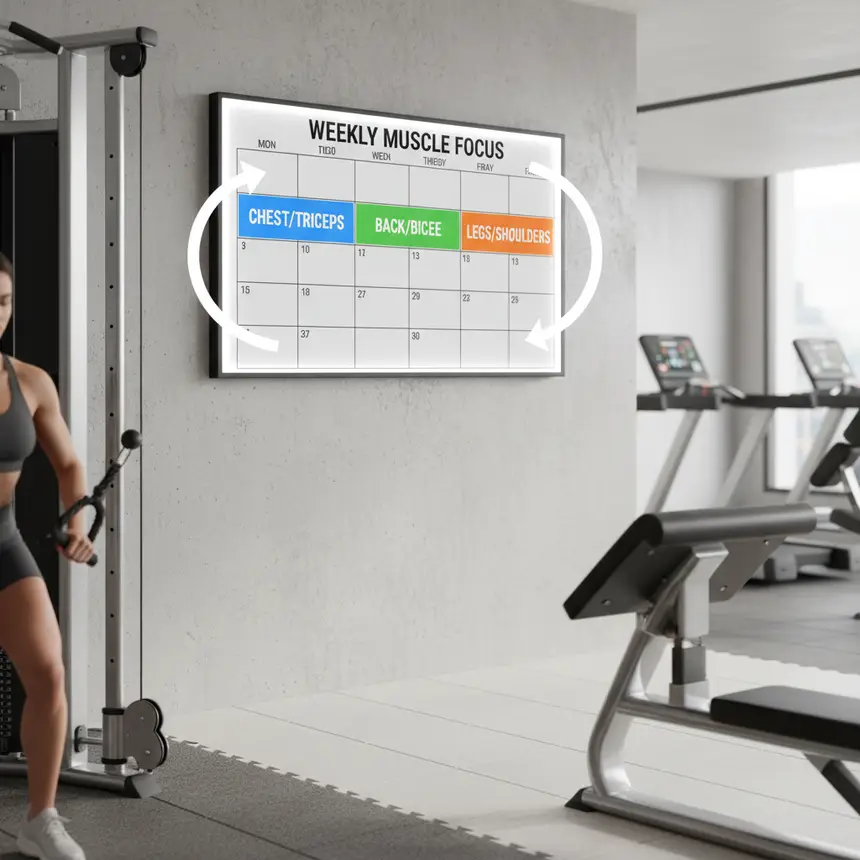
The Science Behind Muscle Gains: Mastering the 3-Day Split
A 3-day workout split involves dividing your entire body into three major muscle groups, which are then trained on separate days throughout the week. This approach allows for more concentrated effort on each muscle group per session, and critically, ensures adequate recovery time before the next training stimulus. Generally, smaller muscle groups require 24-48 hours for recovery, while larger muscle groups need 48-72 hours. The 3-day split is particularly effective because it easily accommodates these recovery periods, allowing you to hit each major muscle group twice a week for optimal frequency.
A popular way to structure a 3-day split often looks like this:
This pairing is strategically designed for maximum efficiency. For example, during back exercises, your biceps are heavily involved as secondary movers, meaning they're already somewhat fatigued. Following up with direct bicep work can lead to a more intense and effective session. Similarly, chest exercises place significant stress on your triceps, making it logical to train triceps afterward for a synergistic effect. The core principle of this split is to prioritize compound, large muscle group exercises first to boost overall training intensity, then follow with smaller muscle group isolation work. Furthermore, when structuring your workouts, it's generally beneficial to emphasize free weight exercises over machine-based ones. Free weights, such as barbells and dumbbells, engage more stabilizing muscles and improve overall coordination and balance, leading to more comprehensive muscle activation and growth. Machines can certainly complement your routine, but free weights should often form the foundation. A typical 3-day split session is most effective when conducted with high intensity and focus, usually lasting between 75 to 90 minutes.
A popular way to structure a 3-day split often looks like this:
- Day 1: Back and Biceps
- Day 2: Chest and Triceps
- Day 3: Legs and Shoulders
This pairing is strategically designed for maximum efficiency. For example, during back exercises, your biceps are heavily involved as secondary movers, meaning they're already somewhat fatigued. Following up with direct bicep work can lead to a more intense and effective session. Similarly, chest exercises place significant stress on your triceps, making it logical to train triceps afterward for a synergistic effect. The core principle of this split is to prioritize compound, large muscle group exercises first to boost overall training intensity, then follow with smaller muscle group isolation work. Furthermore, when structuring your workouts, it's generally beneficial to emphasize free weight exercises over machine-based ones. Free weights, such as barbells and dumbbells, engage more stabilizing muscles and improve overall coordination and balance, leading to more comprehensive muscle activation and growth. Machines can certainly complement your routine, but free weights should often form the foundation. A typical 3-day split session is most effective when conducted with high intensity and focus, usually lasting between 75 to 90 minutes.
- Actionable Tip: Plan your week with three training days followed by a rest day, then cycle back to the first workout. This ensures each muscle group gets approximately 48-72 hours of recovery between sessions.
※ This post contains affiliate links. I may earn a commission at no extra cost to you.


Implementing Your 3-Day Split: Tips for Sustainable Progress
While the 3-day workout split is a powerful tool for muscle development, unlocking its full potential requires adhering to several key principles. First and foremost, consistency is paramount. Regardless of the split you choose, regular and sustained effort is what truly drives results. Second, always prioritize proper form and progressive overload. It’s not just about lifting heavier; it’s about increasing resistance, repetitions, or sets gradually while maintaining excellent technique to ensure your muscles are continually challenged. Third, adequate nutrition and rest are just as crucial as the workout itself. Muscles are broken down during exercise and then repaired and grown during recovery. Ensuring a balanced intake of protein, carbohydrates, and healthy fats, along with 7-8 hours of quality sleep, is fundamental for muscle repair and growth.
Given the high intensity of each session, you might experience significant fatigue initially. However, as your body adapts, you'll find yourself making more efficient gains in strength and muscle mass. It’s vital to listen to your body and be flexible in adjusting your workout intensity or rest periods as needed. Tracking your progress—whether in a notebook or an app—not only boosts motivation but also provides valuable data to inform your routine adjustments. By adopting such a structured workout approach, you can systematically build a stronger, healthier physique.
Given the high intensity of each session, you might experience significant fatigue initially. However, as your body adapts, you'll find yourself making more efficient gains in strength and muscle mass. It’s vital to listen to your body and be flexible in adjusting your workout intensity or rest periods as needed. Tracking your progress—whether in a notebook or an app—not only boosts motivation but also provides valuable data to inform your routine adjustments. By adopting such a structured workout approach, you can systematically build a stronger, healthier physique.
- Actionable Tip: Keep a detailed log of your workouts, noting exercises, weights, reps, and sets for each session. This simple habit helps you monitor progress and make informed adjustments to your routine.
Frequently Asked Questions
Q. Is a 3-day split suitable for beginners?
A. Absolutely. While full-body routines are often recommended for beginners to build foundational strength and movement patterns, a 3-day split can also be highly effective for initial muscle growth. Beginners should focus on mastering proper form with lighter weights before gradually increasing intensity and volume. Consulting a fitness professional for guidance can be very beneficial.
Q. Do I have to stick to specific muscle group pairings (e.g., Back & Biceps, Chest & Triceps)?
A. The recommended pairings are designed for optimal training efficiency. However, you can certainly adjust them based on personal preference, recovery rates, or specific goals. Other common splits include Push (chest, shoulders, triceps), Pull (back, biceps), and Legs. The key is ensuring each muscle group receives sufficient stimulation and recovery time.
Q. How important is nutrition when following a 3-day split?
A. Nutrition is paramount, especially with an intense 3-day split. To support muscle growth and recovery, prioritize adequate protein intake, aiming for 0.7 to 1 gram of protein per pound of body weight (1.6-2.2 grams per kilogram). Carbohydrates are essential for energy, and healthy fats support hormone balance and overall health. Maintain a balanced diet for best results.
Q. What if I experience excessive fatigue while on this routine?
A. Persistent fatigue might indicate that your training intensity or volume is too high, or you're not recovering enough. Consider reducing your sets or reps, or adding an extra rest day. Increasing sleep duration and managing stress are also crucial. Listening to your body's signals and making appropriate adjustments is key for long-term consistency and preventing overtraining.
Q. Why are free weights often recommended over machines?
A. Free weights, like barbells and dumbbells, engage multiple muscle groups and joints simultaneously, promoting better balance, coordination, and overall functional strength. Machines are excellent for isolating specific muscles but may not provide the same comprehensive muscle activation or functional benefits as free weights. Incorporating both effectively balances targeted work with full-body integration.