Unlock the secret to a powerful, well-rounded physique by mastering your rear deltoids. Discover effective cable exercises and expert tips to strengthen this often-neglected muscle group, improving posture and enhancing your overall shoulder aesthetics.

The Unsung Hero: Why Your Rear Deltoids Deserve Attention
Our shoulders comprise anterior, lateral, and rear deltoids. Often overlooked, the rear deltoids are crucial for overall shoulder aesthetics, balance, and maintaining proper posture. While many focus on front and side deltoids, common rounded shoulders in desk-bound individuals are often linked to weak posterior shoulder muscles. These weaken joint stability and can cause discomfort. Balanced shoulder development is vital for good body alignment and enhancing upper body performance. To effectively strengthen this critical muscle group, incorporating targeted cable exercises is highly beneficial.
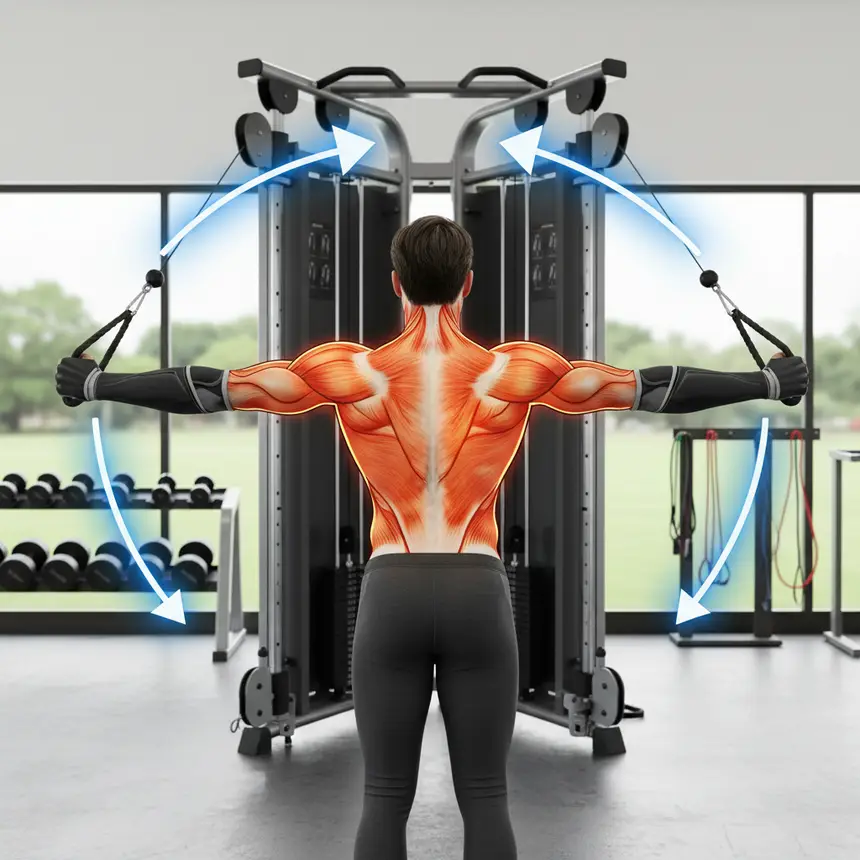
Master Your Rear Deltoids: Effective Cable Exercise Routines and Form Tips
Targeting rear deltoids requires precise activation and keen attention to form, minimizing unwanted trapezius involvement. Cable exercises are highly effective, providing consistent tension, enhancing muscle isolation, and promoting smooth, controlled movements. Incorporate these three essential cable exercises to effectively build and define your rear deltoids for complete shoulder development.1. Modified Cable External Rotation: Strengthens the rotator cuff while engaging rear deltoids. Stand beside a cable machine, grasp the handle with your outer hand, keeping your elbow bent 90 degrees and fixed against your torso. Slowly rotate your arm outwards, initiating movement purely from your rear shoulder muscles. Ensure your elbow remains stationary; focus solely on posterior deltoid contraction, using lighter weights and keeping traps relaxed.2. Seated Cable Face Pull: Performing face pulls seated minimizes lower body involvement, allowing greater rear deltoid isolation. Sit facing the machine, grasp the rope. Elevate elbows slightly above shoulder height, pulling the rope towards your forehead. Squeeze rear deltoids as if meeting in your upper back, then slowly return. Keep elbows high to prevent biceps dominating, and lean back slightly for stability.3. Cross-Grip Cable Reverse Fly: Leverages constant cable resistance for powerful rear deltoid contraction. Center yourself at the machine, set pulleys to shoulder height. Cross-grip handles. Brace your core. With a slight elbow bend, extend arms wide to sides and slightly backward in a broad arc, from head height down to shoulder height. Pause at maximum contraction, then slowly return against resistance. Minimize scapular movement, driving motion primarily from your shoulder joint to isolate posterior deltoids.
※ This post contains affiliate links. I may earn a commission at no extra cost to you.


Maximizing Your Rear Deltoid Workout: Strategic Approaches
To effectively develop your rear deltoids, focus intently on intensity, sequence, and precise form. Start with lighter resistance to truly feel the targeted muscle working, rather than lifting heavy immediately. Emphasize the mind-muscle connection, focusing on the contraction and extension, and gradually increase repetitions.Strategic placement of these cable exercises within your routine enhances effectiveness. An isolation movement like the Cross-Grip Cable Reverse Fly can be a 'finisher' at the end of your workout to fully fatigue the rear deltoids. Alternatively, use lighter sets of a rear deltoid exercise as a 'pre-exhaust' technique at the start to activate these muscles before compound movements, improving overall engagement. Consistently practicing to minimize trapezius involvement and initiating movement from the shoulder joint will lead to well-defined, balanced, and aesthetically pleasing shoulders.
Frequently Asked Questions
Q. How can I minimize trapezius involvement during rear deltoid exercises?
A. To minimize trap involvement, focus on depressing your shoulders (scapular depression) and fixing your elbows. Concentrate on isolating the movement to the shoulder joint, emphasizing the contraction of your rear deltoids with lighter weights and precise form.
Q. What are the advantages of using cables for rear deltoid exercises compared to other equipment?
A. Cables provide consistent tension throughout the entire range of motion, which helps maintain continuous muscle engagement. This constant resistance enhances muscle isolation, promotes smoother movements, and can help reduce the risk of injury while efficiently stimulating muscle growth.
Q. When is the best time to include rear deltoid exercises in my workout routine?
A. You can strategically place them at the beginning of your routine as a 'pre-exhaust' with lighter weights to pre-activate the rear deltoids, or at the end of your workout as a 'finisher' to fully fatigue them after other shoulder exercises. The best timing depends on your personal training goals and overall routine structure.